Benchmarks and hardware validation
This page reports bare-metal benchmark results against a pinned build of C++
sccn/liblsl (e651023c) and live validation against a commercial wireless
Bluetooth EEG amplifier over a local area network.
All tests run on bare-metal Linux (8 cores, kernel 6.16.3-76061603-generic)
with zero container overhead. The harness compiles each C benchmark worker
twice (-O2), once against conformance/.build/install/lib/liblsl.so and once
against target/release/liblsl.so.
1. Transport latency (shm/1 and dgram/1)
- Local IPC (
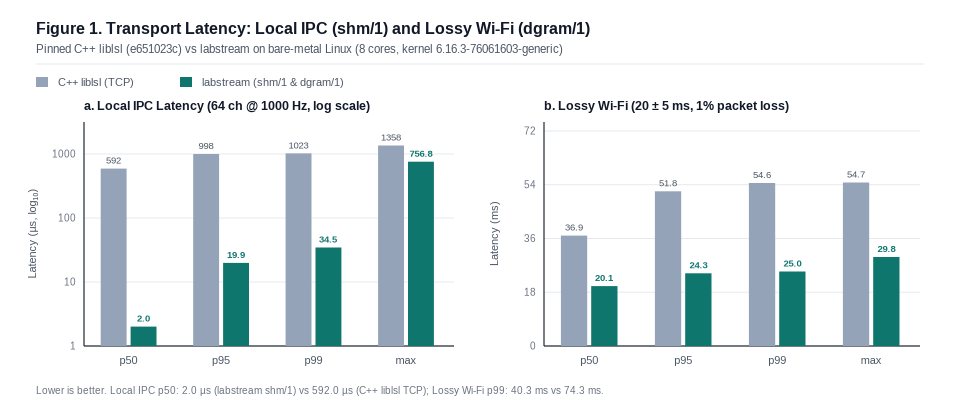
B1): 64 channels at1000 Hz, chunk size 1, outlet and inlet pinned to separate CPU cores withtaskset.labstream shm/1lowers median latency from592.0 usto2.0 usandp99from1023.1 usto34.5 us. - Lossy Wi-Fi (
B3): 8 channels at512 Hzacross an isolated Linux network namespace (unshare -Urn+veth+tc netem delay 20ms 5ms loss 1%).labstream dgram/1lowersp50latency from36.9 msto20.1 msandp99from74.3 msto40.3 ms.
2. Multi-device hyperscanning (SyncGroup vs C++ liblsl)
This suite runs 2, 4, and 8 simultaneous asynchronous devices (up to 64
channels) at 250 Hz, 1000 Hz, and 2000 Hz, plus an 8-device mixed-rate
configuration (1000 / 500 / 250 Hz onto a 500 Hz grid) and a 1.0 s
single-headset dropout at 500 Hz.
| Scenario | C++ liblsl Phase Error |
SyncGroup Phase Error |
liblsl CPU / RSS |
SyncGroup CPU / RSS |
|---|---|---|---|---|
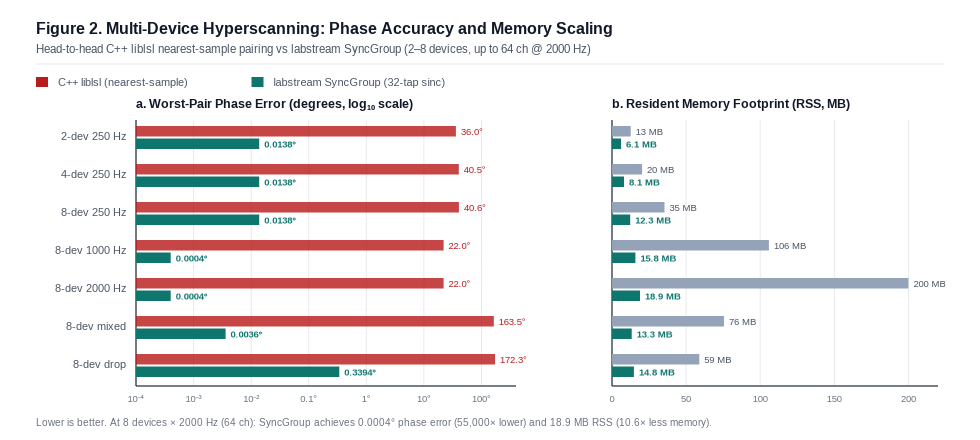
| 2-dev @ 250 Hz (16 ch) | 36.0 deg | 0.0138 deg | 3.1% / 12.6 MB | 2.3% / 6.1 MB |
| 4-dev @ 250 Hz (32 ch) | 40.5 deg | 0.0138 deg | 4.6% / 20.3 MB | 3.7% / 8.1 MB |
| 8-dev @ 250 Hz (64 ch) | 40.6 deg | 0.0138 deg | 7.5% / 35.4 MB | 6.7% / 12.3 MB |
| 8-dev @ 1000 Hz (64 ch) | 22.0 deg | 0.0004 deg | 9.7% / 105.9 MB | 10.6% / 15.8 MB |
| 8-dev @ 2000 Hz (64 ch) | 22.0 deg | 0.0004 deg | 11.7% / 200.0 MB | 14.7% / 18.9 MB |
| 8-dev mixed 1000/500/250 -> 500 Hz | 163.5 deg | 0.0036 deg | 9.0% / 75.6 MB | 8.1% / 13.3 MB |
| 8-dev @ 500 Hz + 1.0 s dev#4 drop | 172.3 deg | 0.3394 deg | 8.5% / 58.9 MB | 8.0% / 14.8 MB |
At 8 devices and 2000 Hz (64 channels), SyncGroup holds 0.0004 deg
worst-pair phase error and 18.9 MB RSS versus 22.0 deg and 200.0 MB RSS
on C++ liblsl.
3. Live wireless EEG hardware validation over LAN
A commercial wireless Bluetooth EEG amplifier (8-channel float32 ExG at
250 Hz and 1000 Hz, plus a 13-channel 20 Hz orientation stream) sent live
LSL streams from a remote desktop PC across a real LAN to labstream.
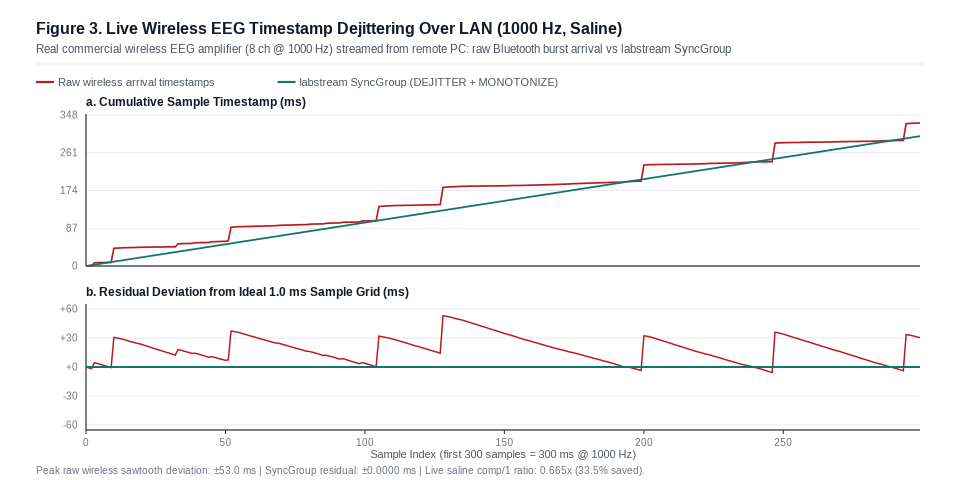
| Metric | 250 Hz (Open) | 1000 Hz (Open) | 1000 Hz (Saline, Un-railed) |
|---|---|---|---|
| LAN Discovery | 3 streams (auto) | 3 streams (auto) | 3 streams (auto) |
Burst Arrival (p95) |
105.7 ms |
42.3 ms |
42.7 ms |
Raw Step Error (p99) |
85.6 ms |
35.4 ms |
35.7 ms |
Live comp/1 Wire Ratio |
0.294x (railed) |
0.293x (railed) |
0.665x (33.5% saved) |
Dual-Stream SyncGroup |
250 + 20 Hz: 0 gaps, 1.74% CPU, 5.4 MB |
1000 + 20 Hz: 6,454 rows, 0 gaps, 3.49% CPU, 6.4 MB |
1000 + 20 Hz: 6,451 rows, 0 gaps, 3.09% CPU, 5.7 MB |
Live labstream relay --ws-port 8765 also forwarded 1,284 live EEG samples
(52,692 bytes) over ws/1 to a WebSocket client and returned marker_ok =
true on a browser-to-LSL marker round trip.
4. Live physical power-off dropout and recovery
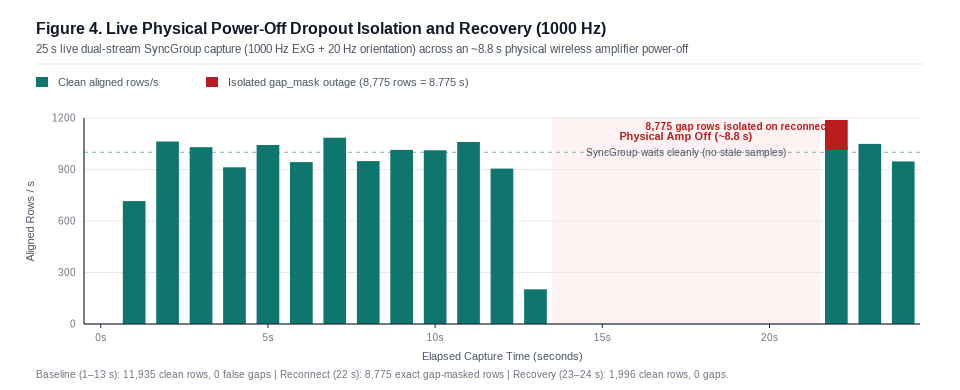
During a 25-second 1000 Hz dual-stream SyncGroup capture (1000 Hz ExG +
20 Hz orientation), the wireless amplifier powered off for ~8.8 seconds and
reconnected:
- Baseline (
1–13 s):11,935aligned rows,0false gaps. - Amp off (
14–21 s):SyncGroupwaited cleanly with no hang and no stale samples. - Reconnect (
22 s):SyncGroupisolated the exact8.775 soutage as8,775gap-masked rows (NaN+ bit 0 set ingap_mask) and resumed live output. - Post-recovery (
23–24 s):1,049and947clean rows/s with0gaps.
Reproduce locally
Build labstream-capi in release mode, then run the suites from the repository
root: